Apache Spark Architecture

Spark & its Features
Apache Spark is an open source cluster computing framework for real-time data processing. The main feature of Apache Spark is its in-memory cluster computing that increases the processing speed of an application. Spark provides an interface for programming entire clusters with implicit data parallelism and fault tolerance. It is designed to cover a wide range of workloads such as batch applications, iterative algorithms, interactive queries, and streaming.
Features of Apache Spark:
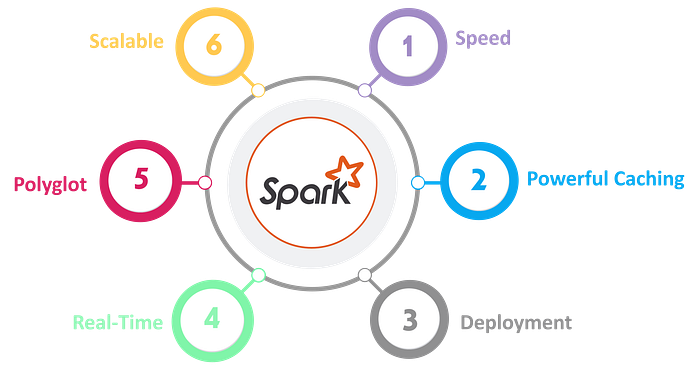
Speed — Spark runs up to 100 times faster than Hadoop MapReduce for large-scale data processing. It is also able to achieve this speed through controlled partitioning.
Powerful Caching — Simple programming layer provides powerful caching and disk persistence capabilities.
Deployment — It can be deployed through Mesos, Hadoop via YARN, or Spark’s own cluster manager.
Real-Time — It offers Real-time computation & low latency because of in-memory computation.
Polyglot — Spark provides high-level APIs in Java, Scala, Python, and R. Spark code can be written in any of these four languages. It also provides a shell in Scala and Python.
Major components of Apache Spark’s distributed architecture.
Spark Architecture Overview
Apache Spark has a well-defined layer architecture which is designed on two main abstractions:
Resilient Distributed Dataset (RDD): RDD is an immutable (read-only), fundamental collection of elements or items that can be operated on many devices at the same time (parallel processing). Each dataset in an RDD can be divided into logical portions, which are then executed on different nodes of a cluster.
Directed Acyclic Graph (DAG): DAG is the scheduling layer of the Apache Spark architecture that implements stage-oriented scheduling. Compared to MapReduce that creates a graph in two stages, Map and Reduce, Apache Spark can create DAGs that contain many stages.
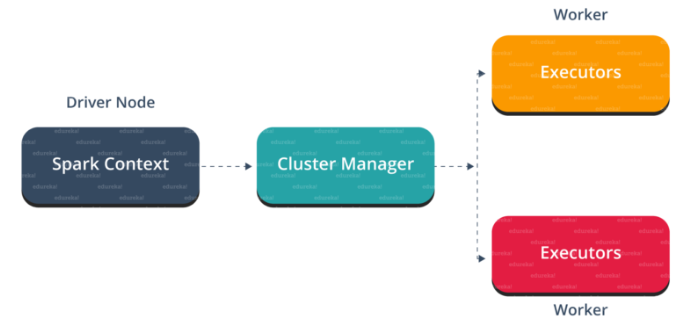
Fig: Spark Architecture
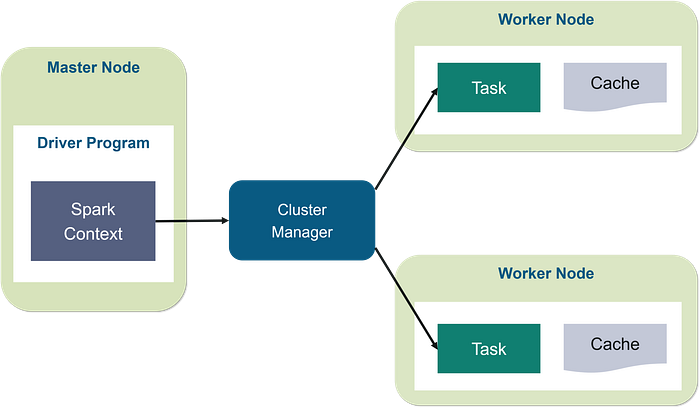
Fig: Spark Architecture
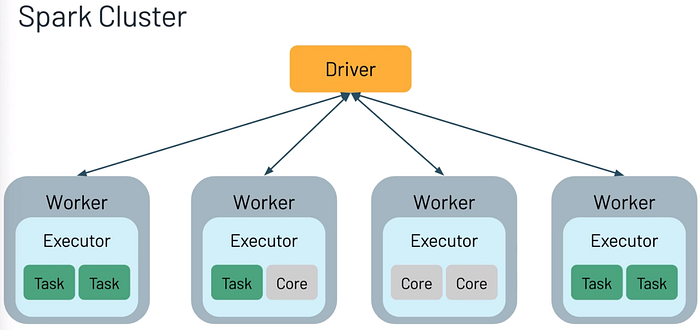
Driver Program in the Apache Spark architecture calls the main program of an application and creates SparkContext. A SparkContext consists of all the basic functionalities. Spark Driver contains various other components such as DAG Scheduler, Task Scheduler, Backend Scheduler, and Block Manager, which are responsible for translating the user-written code into jobs that are actually executed on the cluster.
Spark Driver and SparkContext collectively watch over the job execution within the cluster. Spark Driver works with the Cluster Manager to manage various other jobs. Cluster Manager does the resource allocating work. And then, the job is split into multiple smaller tasks which are further distributed to worker nodes.
Whenever an RDD is created in the SparkContext, it can be distributed across many worker nodes and can also be cached there.
Worker nodes execute the tasks assigned by the Cluster Manager and return it back to the Spark Context.
An executor is responsible for the execution of these tasks. The lifetime of executors is the same as that of the Spark Application. If we want to increase the performance of the system, we can increase the number of workers so that the jobs can be divided into more logical portions.
The secret to Spark’s performance is parallelism
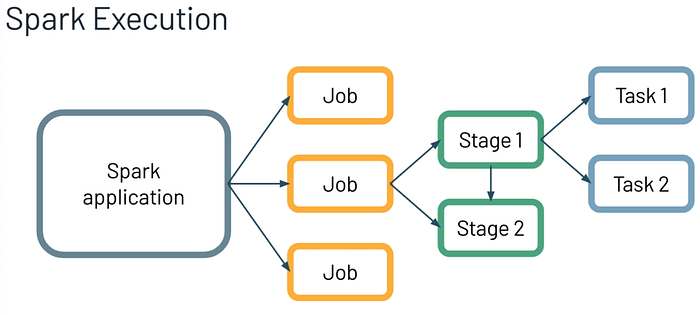
Spark interfaces
There are three key Spark interfaces that you should know about.
Resilient Distributed Dataset (RDD)
Apache Spark’s first abstraction was the RDD. It is an interface to a sequence of data objects that consist of one or more types that are located across a collection of machines (a cluster). RDDs can be created in a variety of ways and are the “lowest level” API available. While this is the original data structure for Apache Spark, you should focus on the DataFrame API, which is a superset of the RDD functionality. The RDD API is available in the Java, Python, and Scala languages.
DataFrame
These are similar in concept to the DataFrame you may be familiar with in the pandas Python library and the R language. The DataFrame API is available in the Java, Python, R, and Scala languages.
Dataset
A combination of DataFrame and RDD. It provides the typed interface that is available in RDDs while providing the convenience of the DataFrame. The Dataset API is available in the Java and Scala languages.
Databricks datasets
Databricks includes a variety of datasets within the Workspace that you can use to learn Spark or test out algorithms. You’ll see these throughout the getting started guide. The datasets are available in the
/databricks-datasetsfolder.
In many scenarios, especially with the performance optimizations embedded in DataFrames and Datasets, it will not be necessary to work with RDDs. But it is important to understand the RDD abstraction because:
The RDD is the underlying infrastructure that allows Spark to run so fast and provide data lineage.
If you are diving into more advanced components of Spark, it may be necessary to use RDDs.
The visualizations within the Spark UI reference RDDs.
When you develop Spark applications, you typically use DataFrames and Datasets.
Spark Eco-System
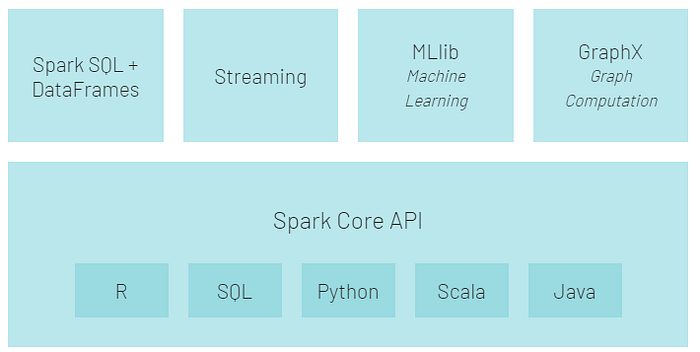
As you can see from the below image, the spark ecosystem is composed of various components like Spark SQL, Spark Streaming, MLlib, GraphX, and the Core API component.
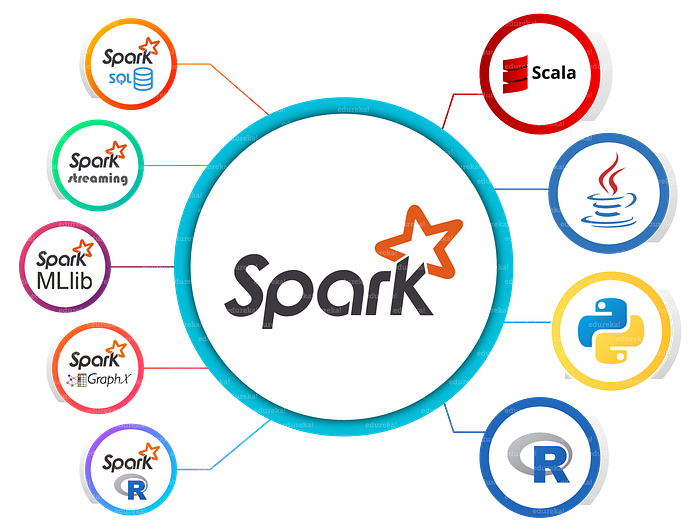
Spark Core Spark Core is the base engine for large-scale parallel and distributed data processing. Further, additional libraries which are built on the top of the core allows diverse workloads for streaming, SQL, and machine learning. It is responsible for memory management and fault recovery, scheduling, distributing and monitoring jobs on a cluster & interacting with storage systems. Spark Core API is available in R, SQL, Python, Scala and Java.
Spark Streaming Spark Streaming is the component of Spark which is used to process real-time streaming data. Thus, it is a useful addition to the core Spark API. It enables high-throughput and fault-tolerant stream processing of live data streams.
Spark SQL + DataFrames Spark SQL is a new module in Spark which integrates relational processing with Spark’s functional programming API. It supports querying data either via SQL or via the Hive Query Language. For those of you familiar with RDBMS, Spark SQL will be an easy transition from your earlier tools where you can extend the boundaries of traditional relational data processing.
GraphX GraphX is the Spark API for graphs and graph-parallel computation. Thus, it extends the Spark RDD with a Resilient Distributed Property Graph. At a high-level, GraphX extends the Spark RDD abstraction by introducing the Resilient Distributed Property Graph (a directed multigraph with properties attached to each vertex and edge).
MLlib (Machine Learning)
MLlib stands for Machine Learning Library. Spark MLlib is used to perform machine learning in Apache Spark.SparkR It is an R package that provides a distributed data frame implementation. It also supports operations like selection, filtering, aggregation but on large data-sets.
Key Concepts & Terms
Shared resources
Parallelization
Partitions
Jobs, Stages, and Tasks
Drivers
Executors
Clusters & Nodes
Slots/Cores/Threads
Filtering
Distributed
Cluster and Nodes
A Cluster is a group of nodes
Nodes are the individual machines within a cluster (generally a VM)
With Databricks, the driver (a JVM) and each executer (each a JVM) all run in their own nodes
Drivers
Runs the Spark application
Assign tasks to slots in an executor
Coordinates the works between tasks
Receives the results, if any
Executors
Provide an environment in which tasks can be run
Leverages the JVM to execute many threads
Slots/Cores/Threads
The lowest unit of parallelization
Generally interchangeable terms, but “slot” is the most accurate term
Execute a set of transformations against a partition as directed by the driver
Parallelization
scale horizontally by adding more executors
scale vertically by adding cores to each executor
Partitions
a ~128MB chunk of the larger dataset
each task processes one and only one partition
the size and record splits are decided by the driver
The initial size is partially adjustable with various configuration options
Applications, Jobs, Stages, and Tasks
The hierarchy into which work is subdivided
One Spark action results in one or more jobs
The number of stages depends on the operations submitted with the application
Tasks are the smallest unit of work
General Notes
Executors share machine level resources
Tasks share executor (JVM) level resources
Rarely are significant performance improvements made by tweaking Spark configuration settings
Counting
Stages
A Stage cannot be completed until all tasks are completed
Spark 3.x can run some stages in parallel (e.g. inputs to a join)
One long-running task can delay an entire stage from completing
The shuffle between two stages is one of the most expensive operations in Apache Spark
Distinct
The Shuffle
Shuffling is the processes of rearranging data within a cluster between stages.
Triggered by “wide” operations:
re-partitioning
ByKey operations (except counting)
Joins, the worse being cross joins
Sorting
Distinct
GroupBy
General Notes
Try to group wide transformations together for the best automatic optimization
Aim for: narrow, narrow, wide, wide, wide, narrow
Avoid: narrow, wide, narrow, wide, narrow, wide
One of the most significant, yet often unavoidable, cause of performance degradation
Just because it’s slow, it doesn’t mean that it’s bad (don’t polish the cannon ball)


